Spring Woodland Backgrounds: Your Digital Forest Toolkit
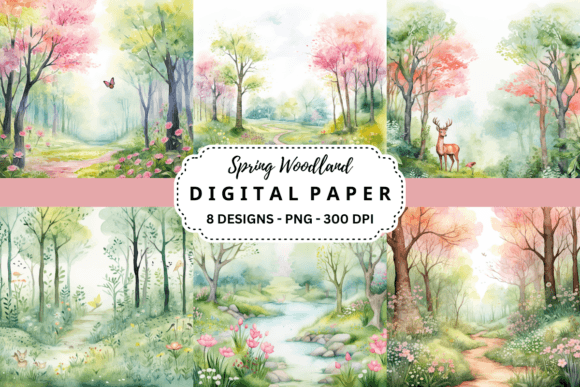
There’s a particular quality to early spring light in a forest. It’s not the deep, saturated green of summer, but a softer, more hopeful palette. Pale greens, the first blush of wildflowers, dappled sunlight filtering through a canopy not yet fully leafed out. Capturing that feeling—the freshness, the organic texture, the serene energy—is exactly what a high-quality set of Spring Woodland Backgrounds provides for your creative work. This isn't just another collection of generic nature photos; it's a versatile toolkit of 8 individual PNG files, each a crisp 3600 x 3600 pixels at 300 DPI, designed to be the foundational layer for countless projects.
The Visual Language of a Spring Woodland
Think of these backgrounds as more than just scenery. They are design assets with a distinct personality. The style leans towards a realistic yet slightly idealized natural aesthetic. You’ll find compositions featuring misty forest paths, carpets of ferns and moss, close-ups of new leaves with intricate veining, and scenes punctuated by the soft blur of bokeh or gentle sun flares. The color story is key: it’s dominated by fresh greens, earthy browns, and soft, neutral sky tones, often with subtle accents of early spring blooms.
This visual language communicates specific qualities. It evokes growth, renewal, tranquility, and authenticity. For a brand or project, using a Spring Woodland Background immediately sets a tone that is both natural and sophisticated. It’s a far cry from sterile, stock imagery. The high resolution ensures that even when cropped tightly for a social media post or printed at a large scale for a banner, the detail—the texture of bark, the delicate shape of a leaf—remains sharp and professional. This is what separates a premium design asset from a low-resolution find.
Where These Backgrounds Truly Shine
The applications are vast, but let’s move beyond a simple list. The real value lies in how these backgrounds integrate into a project's core purpose.
- For Brand Identity & Marketing: A small business focused on organic skincare, sustainable goods, or wellness services can use these backgrounds to build a cohesive visual identity. Imagine a website hero image featuring a product on a bed of spring moss, or consistent social media templates where text overlays a soft, dappled light background. It builds brand perception around natural values without a single word.
- For Digital & Print Publishing: Bloggers and content creators can use them to create stunning featured images for articles on mindfulness, gardening, or seasonal recipes. The backgrounds provide a rich, engaging canvas that makes text pop. In editorial design, a full-bleed woodland background behind a chapter title in a book or a feature in a magazine creates an immersive, high-end feel.
- For Product & Packaging Design: This is where the 300 DPI quality is non-negotiable. Use them for print-on-demand designs on mugs, tote bags, or notebooks. For packaging design, they can form the backdrop for labels on artisanal foods, candles, or teas, instantly conveying a product that is crafted with care and connected to nature.
- For Personal & Creative Projects: Crafters and hobbyists will find endless uses. Create custom invitations for a spring garden party, design unique scrapbooking pages, or produce beautiful, printable wall art. The PNG format with its transparency capability (if the set includes cut-out elements) allows for easy layering in any design software.
Making the Background Work for You: Practical Guidance
Having a powerful asset is one thing; using it effectively is another. Here’s how to approach integrating these Spring Woodland Backgrounds into your workflow.
Evaluating Fit and Readability
Before you commit, consider your project’s primary message. A dense, detailed fern background might overwhelm delicate body text. Conversely, a soft, out-of-focus bokeh background could be perfect for it. Always test your chosen background with your content. Place your logo, your headline, or your product shot on it. Does the background support or compete? The goal is visual hierarchy—your main message should be the hero, with the background providing context and mood.
Font Pairing and Typography Considerations
This is crucial. The organic, natural feel of the woodland pairs best with specific typeface choices. A clean, modern sans serif font for headlines can create a beautiful, contemporary contrast against the organic texture. For a more rustic or elegant feel, a classic serif font or a tasteful script font can work, but legibility is paramount. Avoid overly decorative or handwritten fonts for large blocks of text. The key is balance: let the creative font choices complement the background’s personality without creating visual chaos. Test your font pairing directly on the background to ensure clarity.
Leveraging the File Specifications
The provided specifications are your best friends. The 3600 x 3600 pixel dimension gives you tremendous flexibility. You can crop horizontally for a website banner, vertically for a Pinterest pin, or use the full square for an Instagram post without losing quality. The 300 DPI resolution is essential for any project destined for print. It ensures your designs for posters, invitations, or packaging will be crisp and professional, free from the pixelation that plagues lower-quality assets.
Ultimately, a set of Spring Woodland Backgrounds is more than just pretty pictures. It’s a strategic component in your design toolkit. It offers a ready-made foundation for establishing a mood, building a brand’s visual language, and adding professional depth to a wide array of projects. By choosing the right background for your specific context and pairing it thoughtfully with typography and other design elements, you transform a simple image into a powerful storytelling device that resonates with your audience on a deeper, more authentic level.